
Laboratory Instruments


Capillary Rheometers
Introduction
The Capillary Rheometer Series is designed for accurate characterization of the rheological behavior of polymer melts under controlled temperature, pressure, and shear rate conditions. The instruments provide reliable measurements of melt viscosity and flow properties for thermoplastic materials, thermosetting materials, elastomers, and polymer compounds.
Available in four configurations, the series supports applications ranging from routine quality control to advanced rheological research, offering flexible solutions for universities, research institutes, and industrial laboratories.
Overview
Capillary rheometry is one of the most widely accepted methods for evaluating the flow behavior of polymer melts during processing. By forcing molten material through precision capillary dies under controlled test conditions, the instrument accurately measures pressure, temperature, piston displacement, and flow rate to calculate key rheological parameters including apparent viscosity, shear stress, and shear rate.
The PULIMO Capillary Rheometer Series features servo-controlled loading, precise temperature regulation, intelligent software, and multiple testing modes including constant speed, constant pressure, step shear rate, flow/no-flow analysis, and melt fracture evaluation. Depending on laboratory requirements, users can select compact desktop systems, standard laboratory models, dual-barrel configurations, or advanced research platforms with higher testing capability and greater operational flexibility.
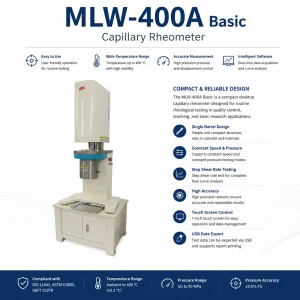
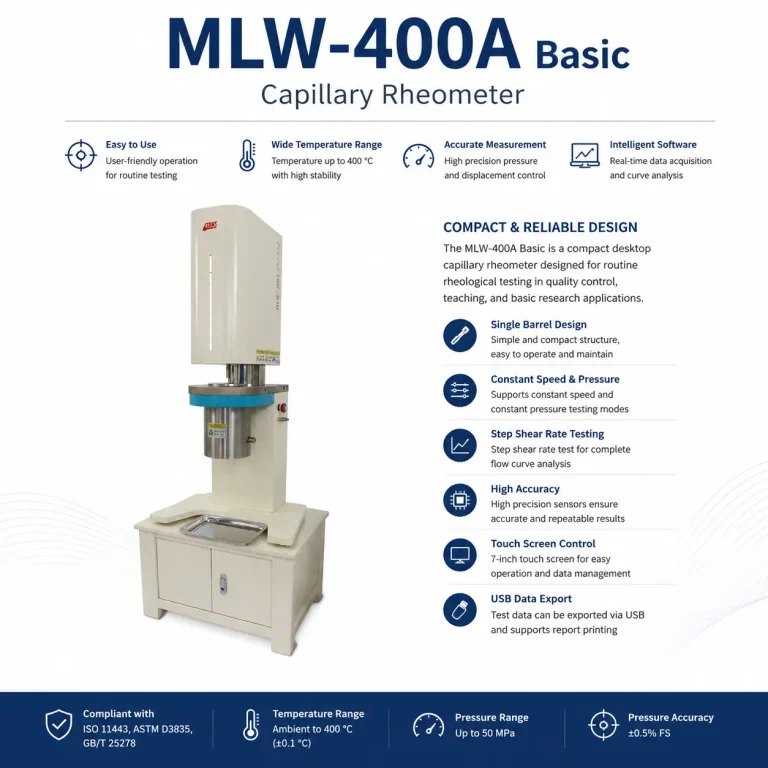
MLW-400A Basic
Introduction
A compact desktop capillary rheometer designed for routine rheological testing, quality control, and educational laboratories. The MLW-400A Basic provides reliable melt viscosity measurements with an economical and easy-to-operate platform.
Key Features
- Compact single-column desktop design
- Single barrel configuration
- Constant speed and constant pressure testing
- Step shear rate testing
- High-speed data acquisition (>100 PPS)
- Multi-curve overlay analysis
- Logarithmic curve display
- Servo-controlled loading system
- Expandable for melt spinning applications
- Easy maintenance and cleaning
Technical Specifications
- Temperature Range: Ambient to 400°C
- Pressure Range: Up to 50 MPa
- Maximum Driving Force: 5 kN
- Heating Rate: 1–6°C/min
- Temperature Resolution: 0.1°C
- Pressure Accuracy: ±0.5% FS
- Speed Range: 0.01–500 mm/min
- Standard Die Sizes: Ø1×5, Ø1×10, Ø1×20, Ø1×40 mm
- Piston Diameter: Ø12 mm
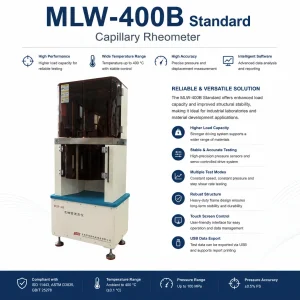
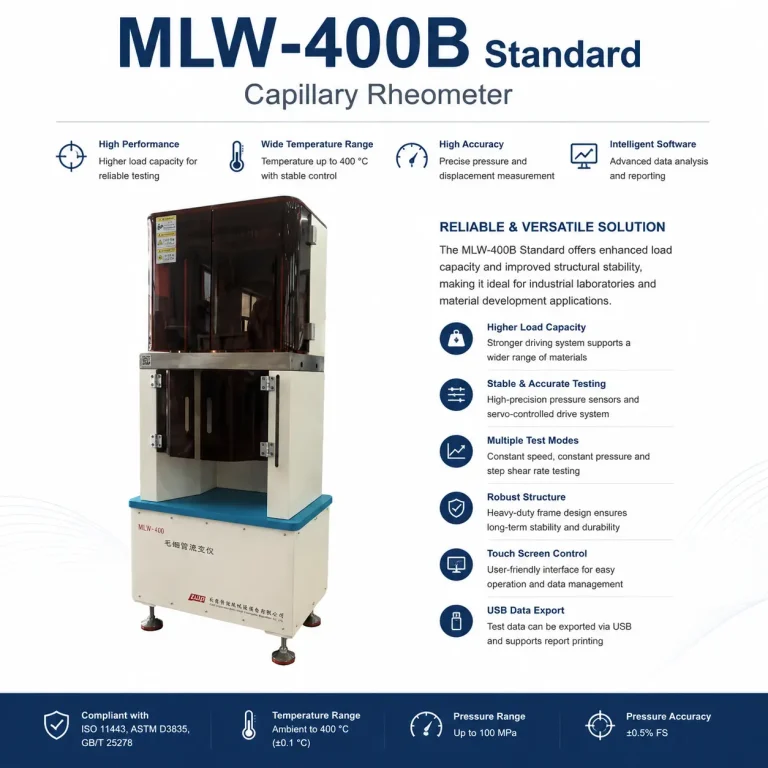
MLW-400B Standard
Introduction
A standard laboratory capillary rheometer offering enhanced loading capacity and improved mechanical rigidity for routine industrial testing and material development.
Key Features
- Heavy-duty H-frame construction
- Single barrel configuration
- High-precision pressure measurement
- Servo-controlled loading system
- Constant speed and constant pressure testing
- Step shear rate testing
- High-speed data acquisition
- Multi-curve comparison
- Expandable system architecture
- Stable long-term operation
Technical Specifications
- Temperature Range: Ambient to 400°C
- Pressure Range: Up to 100 MPa
- Maximum Driving Force: 50 kN
- Heating Rate: 1–6°C/min
- Temperature Resolution: 0.1°C
- Pressure Accuracy: ±0.5% FS
- Speed Range: 0.01–500 mm/min
- Standard Die Sizes: Ø1×5, Ø1×10, Ø1×20, Ø1×40 mm
- Piston Diameter: Ø12 mm
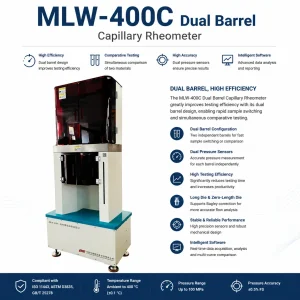
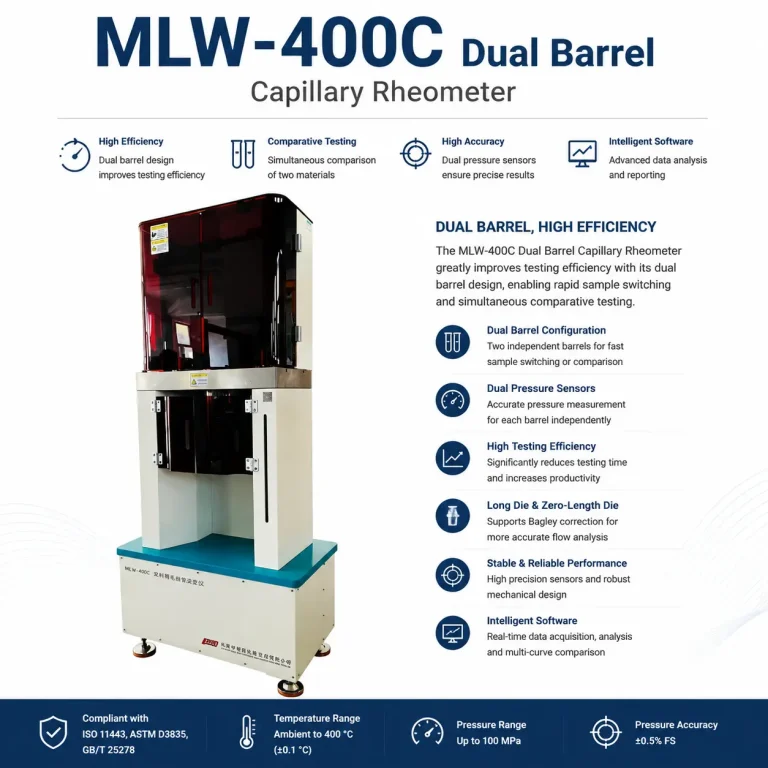
MLW-400C Dual Barrel
Introduction
A dual-barrel capillary rheometer designed for high-efficiency laboratories requiring comparative testing, improved repeatability, and higher testing productivity.
Key Features
- Dual barrel configuration
- Dual pressure sensors
- Simultaneous sample comparison
- Higher testing efficiency
- Bagley correction capability
- Long die and zero-length die configuration
- Simultaneous shear viscosity analysis
- Improved measurement accuracy
- Comparative material evaluation
- High-speed software analysis
Technical Specifications
- Temperature Range: Ambient to 400°C
- Pressure Range: 50 MPa or 100 MPa
- Maximum Driving Force: 10 / 20 / 50 kN
- Heating Rate: 1–6°C/min
- Temperature Resolution: 0.1°C
- Pressure Accuracy: ±0.5% FS
- Speed Range: 0.01–500 mm/min
- Dual Barrel Design
- Long Die & Zero-Length Die Included
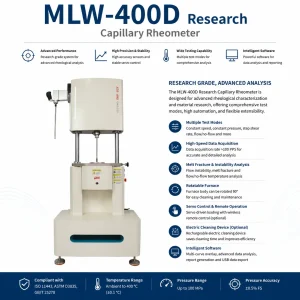
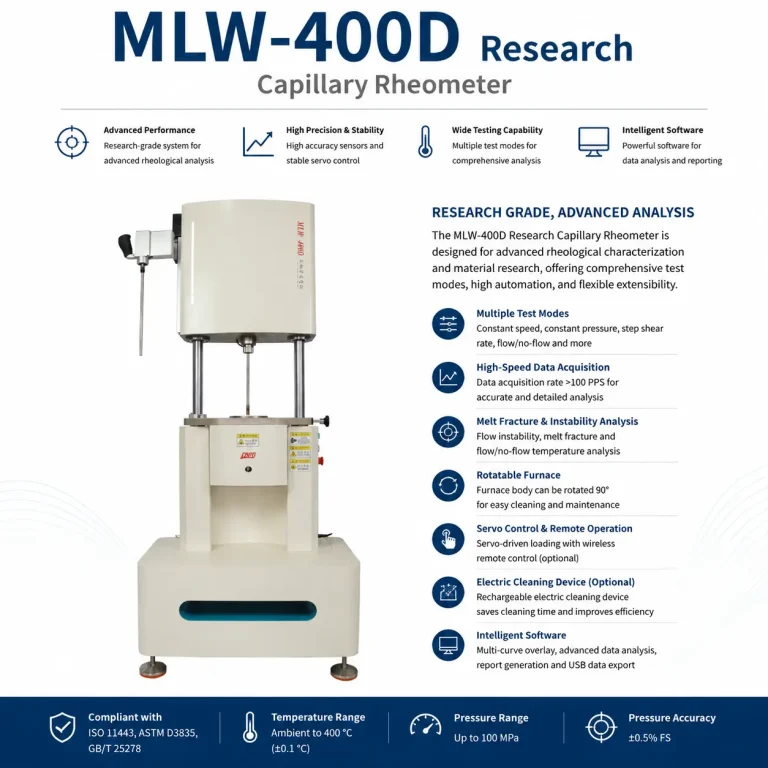
MLW-400D Research
Introduction
A research-grade capillary rheometer developed for advanced rheological characterization, material development, and high-performance polymer research requiring enhanced automation and analytical capability.
Key Features
- Research-grade structural design
- High-speed data acquisition (>100 PPS)
- Constant speed testing
- Constant pressure testing
- Step shear rate testing
- Flow / No-flow analysis
- Melt fracture evaluation
- Flow instability analysis
- Rotatable furnace for easy cleaning
- Servo-driven loading mechanism
- Wireless remote loading control
- Optional electric cleaning system
- Multi-curve overlay and logarithmic analysis
- Expandable to dual-barrel configuration
Technical Specifications
- Temperature Range: Ambient to 400°C
- Pressure Range: Up to 100 MPa
- Maximum Driving Force: 10 / 20 kN
- Heating Rate: 1–10°C/min
- Temperature Resolution: 0.1°C
- Pressure Accuracy: ±0.5% FS
- Speed Range: 0.01–500 mm/min
- Standard Die Sizes: Ø1×5, Ø1×10, Ø1×20, Ø1×40 mm
- Piston Diameter: Ø12 mm
- Optional Rotatable Furnace
- Optional Electric Cleaning System
NOTE:
The PULIMO MLW-400 Capillary Rheometer Series is available in four configurations to meet different laboratory requirements, from routine quality control to advanced rheological research. Although all models are based on the same capillary rheometry principle and comply with the same testing standards, each version is optimized for a specific application scenario.
- MLW-400A Basic – An economical entry-level model designed for routine rheological testing, educational laboratories, and quality control applications. Its compact structure and user-friendly operation make it an ideal choice for everyday testing tasks.
- MLW-400B Standard – A versatile laboratory system offering higher load capacity and enhanced testing performance. It is well suited for industrial R&D laboratories requiring greater precision, stability, and a wider testing range.
- MLW-400C Dual Barrel – Equipped with a dual-barrel configuration, this model significantly improves testing efficiency by enabling rapid sample switching or comparative measurements. It is particularly suitable for quality control laboratories and material development projects involving frequent testing.
- MLW-400D Research – A research-grade platform developed for advanced rheological analysis. With expanded testing modes, higher automation, and optional accessories, it is designed for universities, research institutes, and laboratories working on high-performance polymers and complex material characterization.
Selecting the appropriate model depends on laboratory workload, testing objectives, automation requirements, and future expansion plans. The modular architecture of the MLW-400 Series also allows users to configure the system according to specific research or production needs.
Standards
Designed in accordance with internationally recognized testing standards:
- ISO 11443
Plastics — Determination of the Fluidity of Plastics Using Capillary and Slit-Die Rheometers - ASTM D3835
Standard Test Method for Determination of Properties of Polymeric Materials by Means of a Capillary Rheometer - GB/T 25278
Chinese National Standard, technically equivalent to ISO 11443
Applications
Typical Industries
- Polymer Manufacturing
- Plastic Compounding
- Masterbatch Production
- Research Institutes
- Universities
- Engineering Plastics
- Quality Control Laboratories
- Material Development Centers
- Medical Polymer Research
- Specialty Polymer Processing
Typical Materials
Commodity Plastics
- Polyethylene (PE)
- Polypropylene (PP)
- Polyvinyl Chloride (PVC)
- Polystyrene (PS)
Engineering Plastics
- Polyamide (PA)
- Polycarbonate (PC)
- Polyoxymethylene (POM)
- Polyethylene Terephthalate (PET)
- Polybutylene Terephthalate (PBT)
Elastomers
- Thermoplastic Polyurethane (TPU)
- Thermoplastic Elastomers (TPE)
- Thermoplastic Vulcanizates (TPV)
- Rubber Compounds
Filled & Reinforced Materials
- Glass Fiber Reinforced Compounds
- Carbon Fiber Reinforced Compounds
- Mineral Filled Plastics
- Flame-Retardant Compounds
High-Performance Polymers
- Polyether Ether Ketone (PEEK)
- Polyether Ketone Ketone (PEKK)
- Polyphenylene Sulfide (PPS)
- Polyetherimide (PEI)
- Liquid Crystal Polymer (LCP)
Polymer Blends & Masterbatches
- Polymer Blends
- Color Masterbatches
- Additive Masterbatches
- Functional Compounds
Interested in This Product?
If you’re interested in this product or have a specific application in mind, feel free to contact us. Share your material, process requirements, production capacity, and application details, and our team will recommend the most suitable configuration and technical solution to meet your production needs.
Our engineering team will recommend the most suitable solution.