A Good Laboratory Instrument Doesn’t Fight the User
Engineering Notes #6 A Good Laboratory Instrument Doesn…
Engineering Notes #6
A Good Laboratory Instrument Doesn’t Fight the User
Many people evaluate a laboratory instrument by looking at its specifications:
Higher precision.
More functions.
Faster testing.
These are all important.
But after years of working with laboratory equipment, I’ve come to believe that another factor often determines whether an instrument is truly successful.
A good laboratory instrument should never force the user to adapt to the machine.
Instead, the machine should adapt to the way people naturally work.
This may sound simple, but it affects almost every engineering decision.
Think about a routine laboratory test.
The operator installs the specimen, adjusts the fixture, starts the test, waits for the results, removes the sample, and prepares for the next one.
If every step requires unnecessary adjustments, repeated calibration, awkward loading angles, or complicated software operations, the instrument becomes mentally exhausting to use.
The measurement may still be accurate.
But the engineering has already failed.
Good engineering reduces cognitive load.
Operators should spend their attention on understanding materials—not on figuring out how to operate the machine.
That’s why details matter.
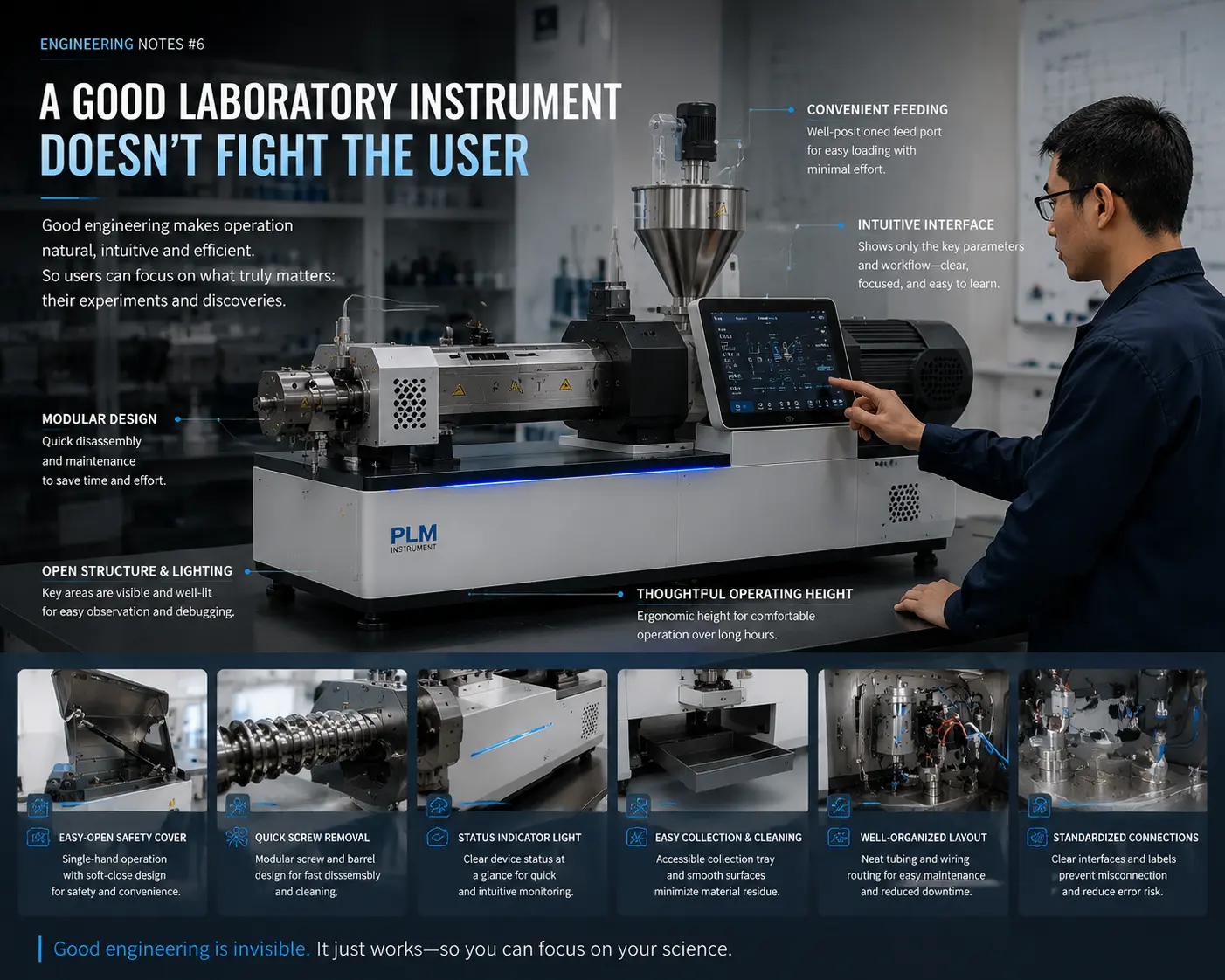
A fixture that naturally guides the specimen into position.
A door that opens in the most intuitive direction.
Controls arranged in the sequence people actually use.
A software interface that highlights only the parameters that matter.
Automatic recovery after unexpected interruptions.
Clear maintenance access.
These features rarely appear in product brochures.
Yet they determine how the instrument performs over thousands of tests, over many years, and across different operators.
In my experience, laboratory instruments are not just measurement devices.
They are human-machine systems.
The best engineering often becomes invisible because users simply feel that “everything works naturally.”
When an operator never has to stop and think about the machine, they can focus entirely on the experiment.
That is when the instrument has truly achieved its purpose.
Good engineering isn’t only about making machines more capable.
It’s also about making people more effective.
And sometimes, the most successful engineering is the kind that users hardly notice at all.