Engineering Notes #3
PVC Isn’t Plasticized by Heat. It’s Plasticized by Force.
One assumption has followed PVC processing for decades:
Raise the temperature, and the material will plasticize.
It sounds reasonable. The barrel is heated, the screw rotates, and the material eventually becomes a continuous melt.
But after years of working with PVC extrusion systems, I came to believe that this explanation misses the real mechanism.
Unlike many thermoplastics, PVC does not simply melt when enough heat is applied.
Its transformation is a fusion process, where powder particles gradually become a continuous viscoelastic material through a carefully controlled combination of mechanical deformation and thermal energy.
Heat is necessary. But heat is not what drives the process.
The real driver is how mechanical energy is delivered to the material.
Traditional extrusion systems often respond to unstable fusion by increasing barrel temperature, screw speed, or shear intensity. These methods can improve fusion, but they also introduce new problems: higher energy consumption, localized overheating, a narrower processing window, and a greater risk of thermal degradation.
That led me to ask a different question.
Instead of adding more heat, what if we redesigned how force is applied throughout the extrusion process?
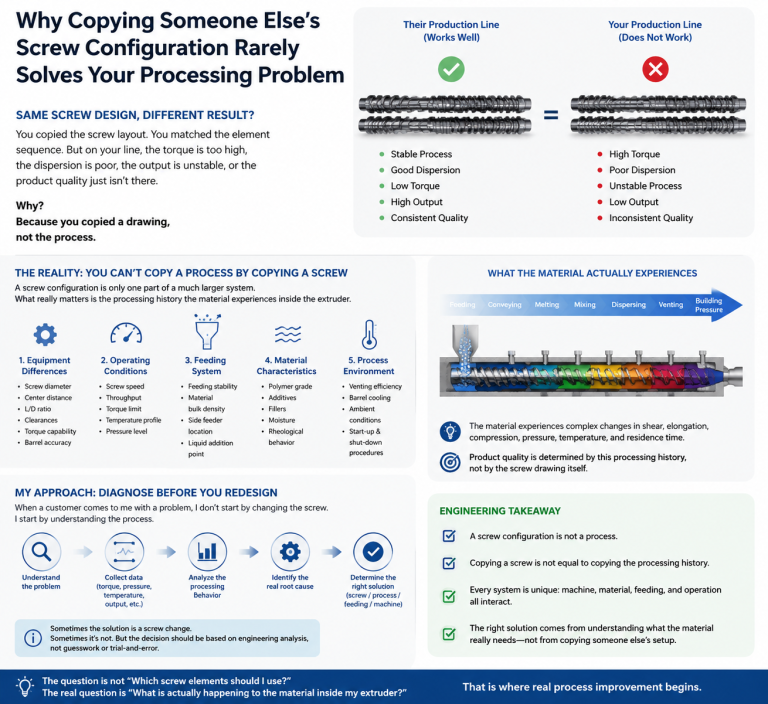
This shifted my attention away from temperature settings and toward screw geometry.
The objective was never to generate more shear. It was to create a more uniform mechanical field, allowing every particle to experience a similar deformation history.
When the mechanical history becomes more consistent, fusion becomes more synchronized. Localized shear peaks are reduced. Viscous dissipation becomes more evenly distributed. As a result, the system no longer depends on excessive external heating to achieve stable plasticization.
The outcome appears counterintuitive at first.
Lower processing temperatures. More stable processing.
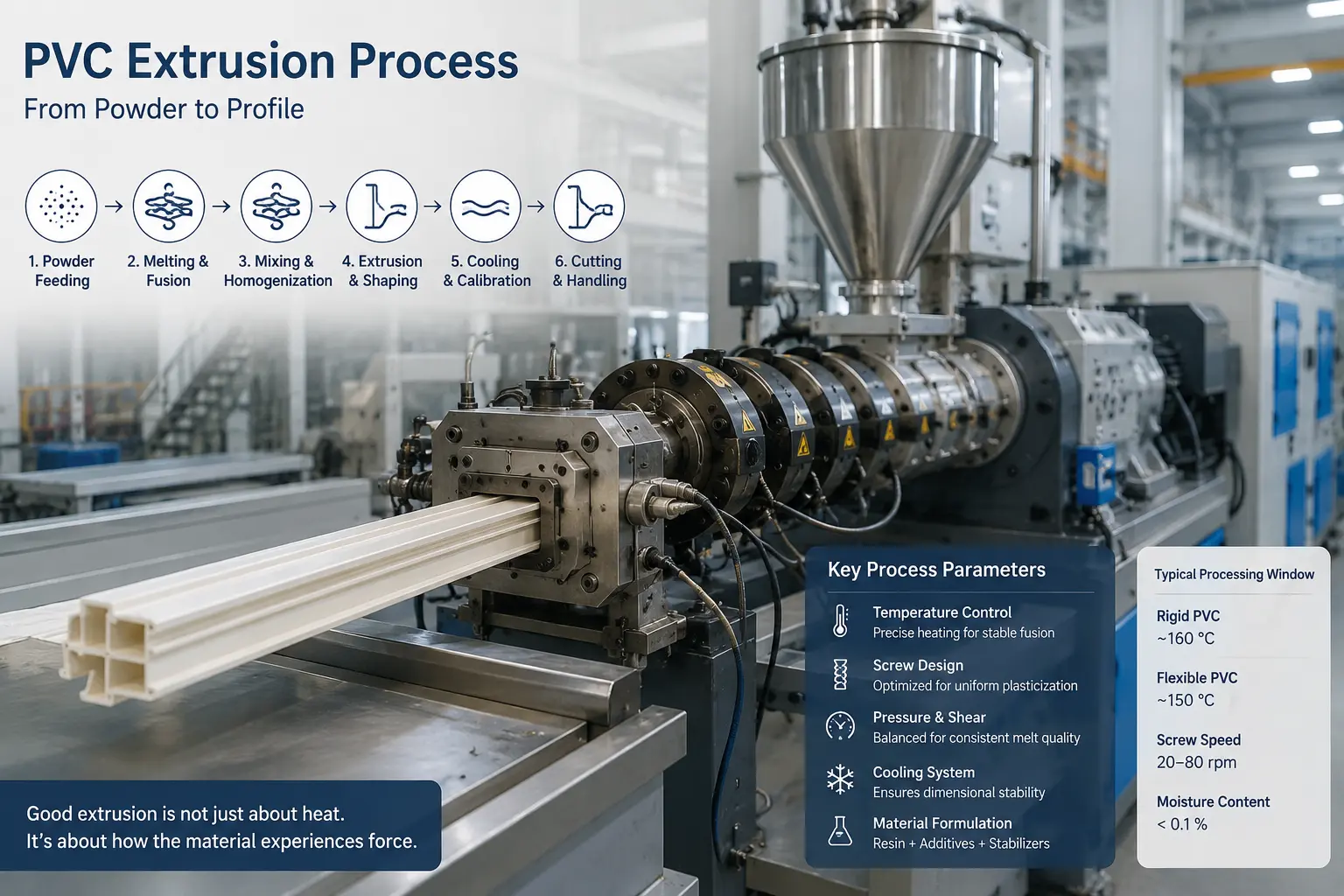
During our validation work, rigid PVC was processed at approximately 160°C, while flexible PVC operated around 150°C. At the same time, we observed lower motor current, improved fusion consistency, and a broader processing window compared with conventional systems.
For me, however, these numbers are not the most important part.
They are only the consequence.
The more meaningful question is whether we have been focusing on the wrong variable.
In extrusion, we spend countless hours discussing temperature profiles, pressure, and screw speed. Yet we rarely ask what kind of mechanical history the material experiences before it reaches a fully plasticized state.
For PVC, plasticization is not simply a thermal event. It is the result of mechanical and thermal histories working together.
When the force field is designed more intelligently, temperature naturally becomes less demanding. Lower energy consumption follows. Process stability improves. And material performance may benefit as well.
This experience has reinforced a belief that has shaped much of my engineering work:
The best engineering solutions rarely come from adding more energy. They come from directing energy more effectively.
Reducing temperature was never the goal. Designing a better way to use energy was.