
Why Copying Someone Else’s Screw Configuration Rarely Solves Your Processing Problem?
A screw configuration is only one part of the extrusion process. Real engineering solutions come from understanding how the material experiences the entire processing history inside the extruder.
Engineering Notes #9
Why Copying Someone Else’s Screw Configuration Rarely Solves Your Processing Problem?
One question comes up repeatedly in polymer processing projects:
“We copied the screw configuration from a successful production line. The screw elements, their sequence and their positions are almost identical. Why are our results still completely different?”
This situation is surprisingly common. The process may suffer from excessive torque, poor dispersion, unstable product quality or a significant drop in performance as throughput increases. In many cases, the first instinct is to redesign the screw configuration.
I believe that is often the wrong place to start.
The real question is not whether the screw configuration is correct. The real question is: What is the material actually experiencing inside your extrusion process?
Over the years, screw configurations have almost become a language of their own in the extrusion industry. Engineers exchange screw drawings, compare kneading block arrangements and search for the ‘right’ configuration for a particular formulation. This easily creates the impression that a successful screw design can simply be copied from one production line to another.
However, a screw configuration is only a geometric arrangement of screw elements. It is not the process itself.
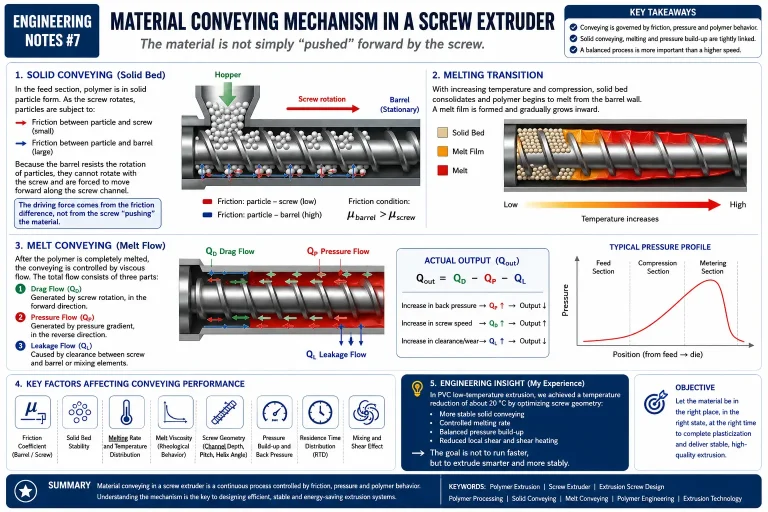
What determines product quality is the complete processing history of the material as it travels through the extruder. During conveying, compaction, melting, plasticization, mixing, devolatilization and pressure build-up, the material experiences continuous changes in shear, elongational deformation, pressure, temperature and residence time. Those changes ultimately determine the structure and performance of the final product.
This is precisely why two extruders equipped with identical screw configurations can produce very different results.
Machine design is one reason. Two ’65 mm twin-screw extruders’ may differ substantially in screw geometry, center distance, specific torque, L/D ratio, machining accuracy and mechanical clearances. Those seemingly small differences alter how energy is transferred into the material.
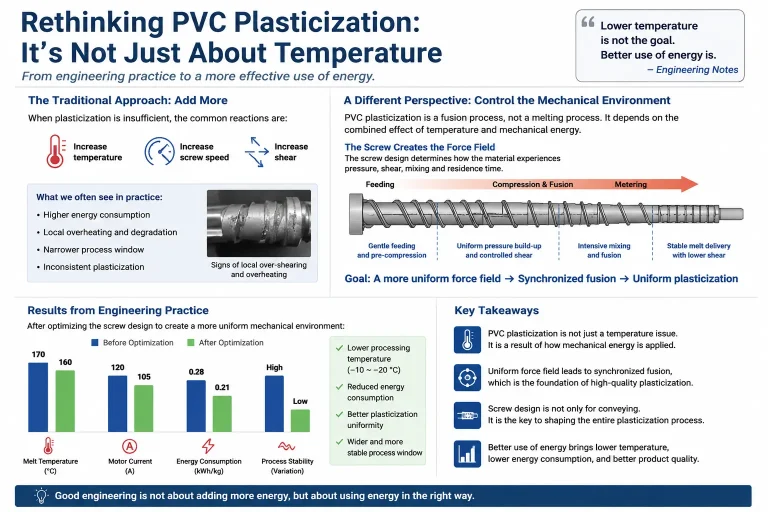
Processing conditions are equally important. The same screw configuration running at 300 rpm behaves very differently from one operating at 600 rpm. Screw speed changes residence time, fill level, shear frequency and specific energy input. Even with the same throughput, the material may experience a completely different processing history.
Feeding conditions add another layer of complexity. Main feeding, side feeding, liquid injection, bulk density, feeding stability and venting efficiency all influence how the extruder is filled and how the material flows through the machine.
In other words, the screw configuration is only one variable in a much larger processing system.
When customers ask me to recommend a new screw configuration, I rarely begin with the screw drawing itself. Instead, I try to understand where the process begins to deviate from what the material actually requires.
If the problem is excessive torque, I do not immediately suggest removing kneading blocks. I first evaluate plasticization, conveying behavior, filling conditions, feeding stability, temperature profile and machine loading.
If dispersion is poor, adding more aggressive mixing elements is not always the answer. In some cases, the material has not reached the appropriate molten state before entering the mixing section. In others, the location of the mixing zone itself is the real issue.
Without identifying the root cause, even an excellent screw configuration may fail to solve the problem.
Over the years, I have become convinced that successful screw design is not about arranging screw elements. It is about understanding the processing history the material requires and ensuring the machine can consistently deliver that history.
Only after understanding the process can we decide whether the solution is to modify the screw configuration, optimize operating conditions, improve the feeding system or address the limitations of the equipment itself.
For me, a screw configuration is not the process. It is simply one engineering tool used to achieve the process.
Copying someone else’s screw drawing does not mean copying their process. The real engineering challenge is understanding what actually happens to the material inside the extruder.
And more often than not, that is where the real solution begins.