Material Conveying Mechanism in a Screw Extruder: Why Polymer Is Not Simply “Pushed” Forward
Engineering Notes #7 Material Conveying Mechanism in a …
Engineering Notes #7
Material Conveying Mechanism in a Screw Extruder: Why Polymer Is Not Simply “Pushed” Forward
One of the most common misconceptions in polymer extrusion is that the screw simply pushes the material toward the die.
From an engineering perspective, this is only a simplified explanation.
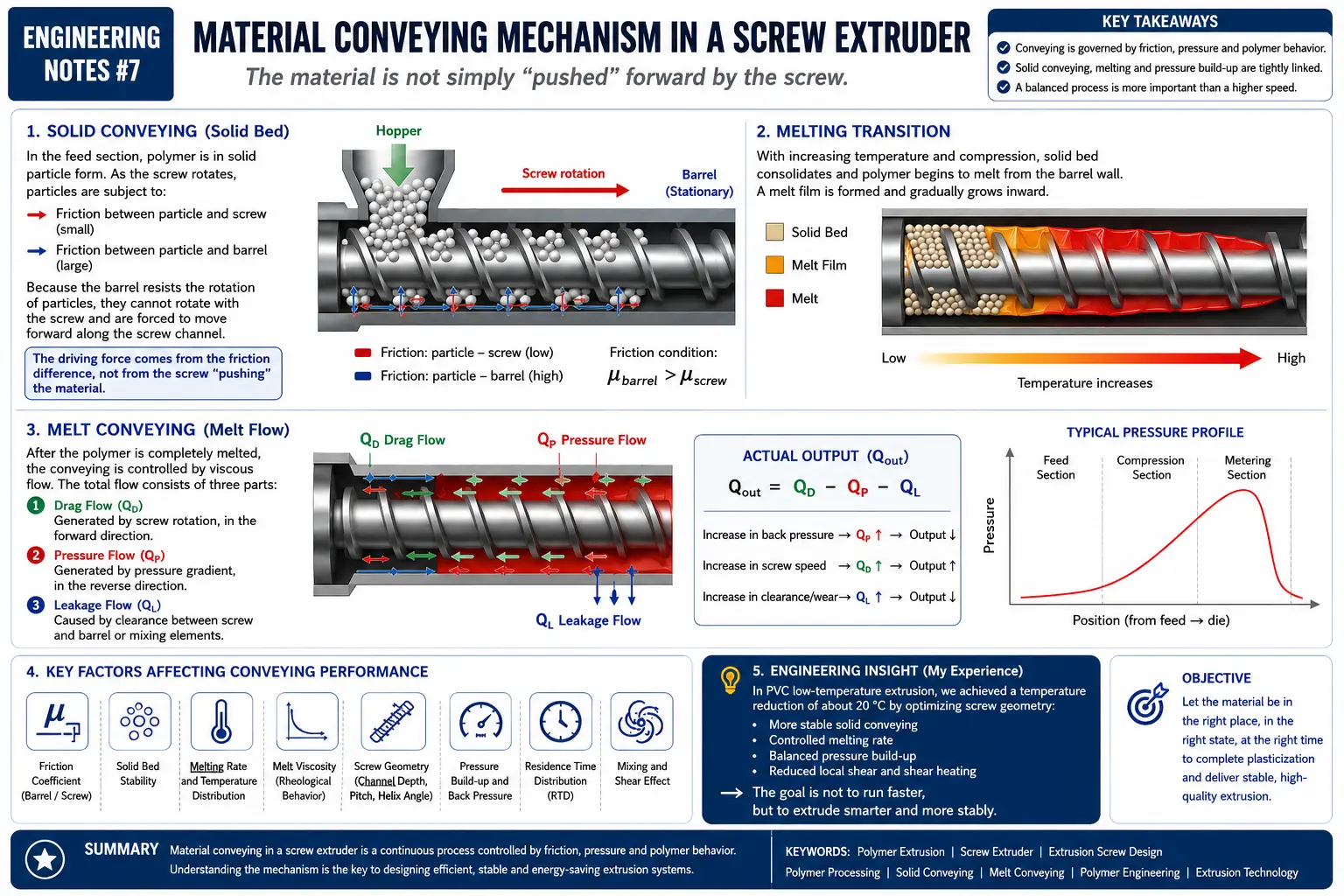
During the solid conveying stage, polymer pellets do not move forward like a nut traveling along a threaded bolt. Instead, their movement is governed by the difference in friction between the rotating screw and the stationary barrel. Because the barrel prevents the solid bed from rotating with the screw, the material is forced to move axially along the screw channel. This friction-driven mechanism is the fundamental principle of solid conveying in a screw extruder.
As the polymer heats up, the conveying mechanism changes significantly. Once melting begins, the material behaves as a highly viscous fluid rather than a collection of solid particles. The output is then determined by the balance between drag flow, generated by screw rotation, and pressure flow, created by die resistance. The interaction of these two flow components directly influences throughput, melt pressure, temperature distribution, and overall process stability.
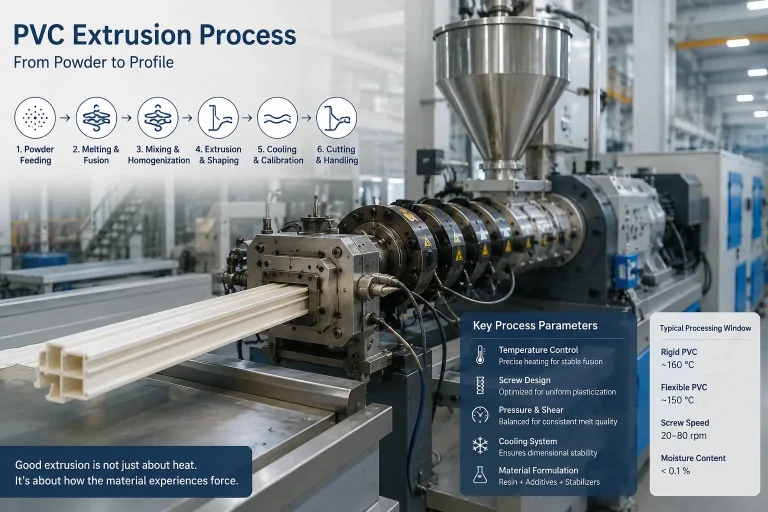
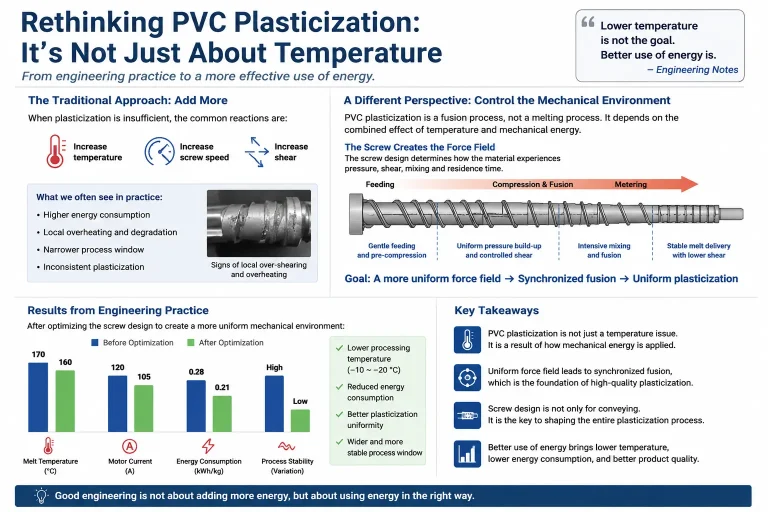
Based on my experience in PVC low-temperature extrusion, I have found that many extrusion problems are not caused by insufficient conveying capacity, but by an imbalance between solid conveying, melting rate, pressure build-up, and shear distribution. Simply increasing screw speed or shear intensity may accelerate melting, but it also generates additional shear heating, narrows the processing window, and increases the risk of thermal degradation—especially for heat-sensitive polymers such as PVC.
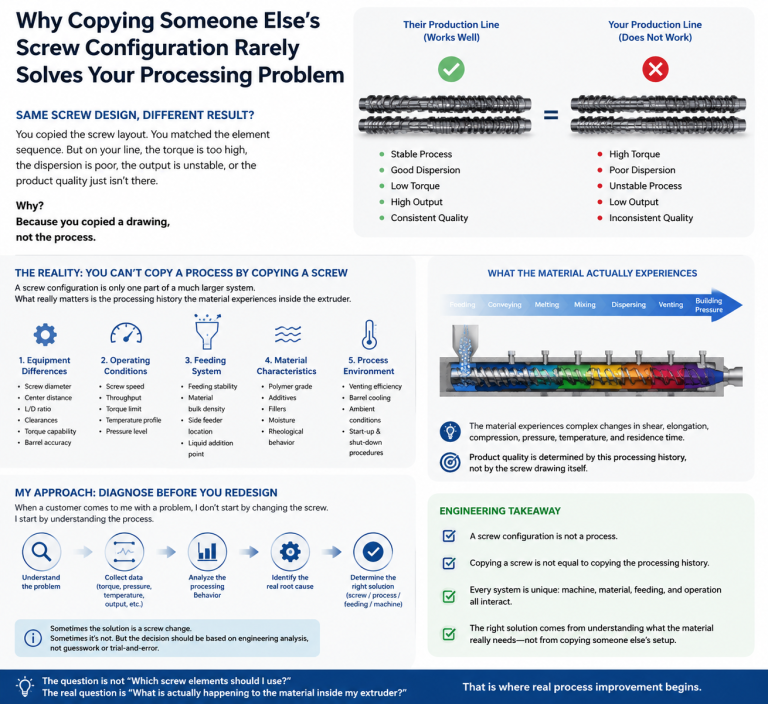
For this reason, my approach to extrusion screw design is not focused solely on maximizing output. Instead, I emphasize optimizing screw geometry to coordinate material conveying, melting behavior, pressure development, and temperature uniformity throughout the extrusion process.
A well-designed extrusion system is not the one that moves material faster. It is the one that allows the material to melt at the right location, under the right conditions, with the right level of shear.
In my view, this balance is the essence of polymer engineering and the foundation of stable, efficient, and high-quality polymer processing.