Higher PCR Content Changes More Than Just the Material
How increasing post-consumer recycled content affects t…
How increasing post-consumer recycled content affects the processing window, equipment requirements, and final product performance
The use of post-consumer recycled material (PCR) is increasing rapidly across the plastics industry.
Packaging regulations, sustainability targets, brand commitments, and circular-economy initiatives are encouraging manufacturers to incorporate more recycled material into plastic products.
For many processors, the question is moving from:
“Should we use PCR?”
to:
“How much PCR can we use?”
10%, 20%, 30%, 40% — or even higher.
But from a polymer processing perspective, increasing PCR content is not simply a matter of changing one number in the formulation.
Higher PCR content can change the entire processing window.
Why PCR Is Different From Virgin Polymer
Virgin polymer is normally supplied within relatively controlled specifications.
Depending on the material and grade, processors can work with information such as:
- Melt flow index or melt flow rate (MFI/MFR)
- Density
- Molecular structure
- Additive package
- Mechanical properties
- Recommended processing conditions
PCR has a very different history.
Before reaching the processing plant again, the material may already have experienced:
Product use → Collection → Sorting → Washing → Shredding → Melting → Filtration → Repelletizing
Its composition may also vary according to the source of the collected waste.
As a result, PCR may contain differences in:
- Polymer grades
- Molecular weight and degradation level
- Residual additives
- Small amounts of other polymers
- Moisture and volatile components
- Printing inks and residues
- Contamination
- Thermal and mechanical history
This leads to one of the most important challenges in PCR processing:
The average material property matters, but material variability may matter even more.
Higher PCR Content Can Narrow the Processing Window
Consider a production line originally processing:
Virgin Polymer + 10% PCR
If the PCR content is increased to:
Virgin Polymer + 30–40% PCR
the change is not limited to material cost or recycled-content percentage.
The higher PCR level can influence several material characteristics at the same time.
For example:
Melt viscosity may change.
Melt strength may change.
Thermal stability may decrease.
Contamination levels may increase.
Compatibility between different polymer fractions may become more important.
And most importantly, batch-to-batch variation may become more visible in the production process.
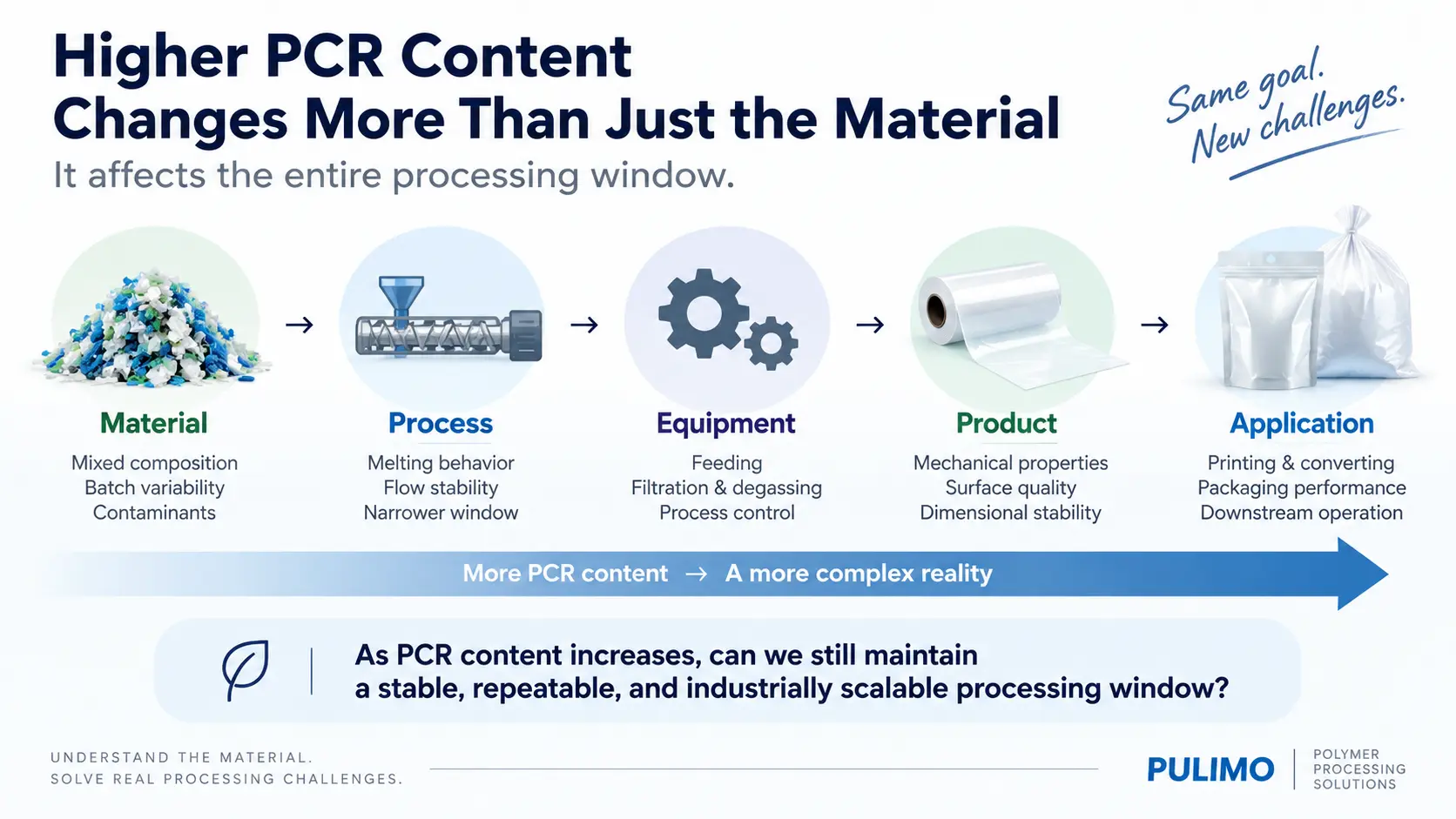
The result is a chain reaction:
Material
Mixed composition, contamination, degradation, and batch variability.
↓
Process
Changes in melting behavior, flow stability, pressure, temperature sensitivity, and processing stability.
↓
Equipment
Greater attention may be required for feeding, filtration, degassing, cooling, and process control.
↓
Product
Mechanical properties, surface quality, dimensional stability, appearance, and consistency may be affected.
↓
Application
The impact can eventually reach printing, converting, packaging, or downstream automated production.
This is why the PCR challenge does not stop at the material hopper.
Similar MFI Does Not Always Mean Similar Processing Behavior
MFI/MFR is one of the most commonly used parameters when evaluating polymer materials.
It is useful because it provides a quick indication of melt flow behavior under defined test conditions.
But PCR is often more complicated.
Two PCR batches can have similar MFI values while having different:
- Polymer compositions
- Molecular weight distributions
- Degradation histories
- Contamination levels
- Melt elasticity
- Interfacial behavior between different polymer fractions
Therefore, two materials with similar MFI values do not necessarily behave identically inside an extruder.
This distinction becomes increasingly important as PCR content rises.
Instead of asking only:
“What is the MFI of this PCR?”
it may be more useful to ask:
“How stable is its processing behavior under the actual conditions of our production process?”
For higher-PCR formulations, material characterization should increasingly focus on understanding the processing window, not only a single material specification.
Feeding Stability Can Become a Process Issue
One of the first challenges may occur before melting even begins.
PCR can be supplied as pellets, regrind, flakes, agglomerates, or other irregular forms.
Compared with uniform virgin pellets, these materials may have:
- Lower bulk density
- Irregular particle geometry
- Poorer flowability
- Greater bulk-density variation
- Bridging or feeding problems
These differences can influence the stability of material entering the extruder.
If the feed rate fluctuates, downstream melt pressure and output may also fluctuate.
Therefore, for some PCR applications, stable material handling and feeding can be just as important as the extruder itself.
Melt Filtration Becomes Increasingly Important
Contamination is another major difference between virgin polymer and PCR.
Depending on the source and recycling process, PCR may contain small amounts of:
- Paper
- Metal particles
- Wood
- Labels
- Adhesive residues
- Degraded polymer
- Other foreign materials
Once the polymer melts, these contaminants need to be managed.
As contamination increases, the filtration system may experience:
Higher pressure rise → More frequent screen changes → Greater process disturbance → Reduced continuous operating time
This means screen changer and filtration-system selection should not be treated as an isolated equipment decision.
It should be based on:
Contamination level + Required filtration accuracy + Throughput + Allowable pressure fluctuation + Continuous production requirement
For many recycling processes, filtration stability can become one of the key factors determining overall line performance.
Degassing May Become More Critical
PCR can also introduce moisture and volatile components into the extrusion process.
Possible sources include:
- Residual washing moisture
- Printing inks
- Adhesives
- Organic residues
- Degradation products
- Other volatile contaminants
If these components remain in the melt, they may contribute to bubbles, odor, surface defects, unstable extrusion, or reduced product quality.
Depending on the material and application, the extrusion system may therefore require effective atmospheric venting or vacuum degassing.
But again, the correct solution depends on the material.
The engineering question is not simply:
“Does the extruder have a vacuum port?”
It is:
“What needs to be removed from the melt, how much needs to be removed, and under what processing conditions?”
The Extruder Is Only One Part of the PCR Processing System
When discussing PCR processing, equipment selection often begins with the extruder:
Single-screw or twin-screw?
What L/D?
What screw diameter?
What motor power?
These are important questions, but they are not the complete process.
A stable PCR processing line may involve the interaction of:
Material handling → Feeding → Extrusion → Degassing → Filtration → Pelletizing or Product Forming → Cooling → Process Control
If PCR variability increases, every part of this chain may influence the final result.
This leads to a different way of thinking about equipment selection.
Instead of asking:
“Which extruder is best for PCR?”
we should first ask:
“What functions must the entire processing system provide for this particular PCR feedstock?”
From PCR Percentage to Processing Capability
As recycled-content targets increase, PCR percentage will become an increasingly important specification.
But percentage alone does not tell us whether a process is technically stable.
A more complete engineering approach is:
PCR Source → Material Characterization → Formulation → Processing Window → Equipment Configuration → Product Performance
Each step influences the next.
If the feedstock changes, the formulation may need adjustment.
If the formulation changes, the processing window may change.
If the processing window changes, equipment configuration and operating conditions may also need to change.
And ultimately, all of these factors determine whether the final product meets its application requirements.
The Real Question Is Process Stability
Increasing recycled content is an important direction for the plastics industry.
But successful PCR processing requires more than simply replacing virgin resin with recycled material.
The higher the PCR content becomes, the more important it is to understand:
Material variability
Rheological behavior
Feeding stability
Filtration requirements
Degassing requirements
Process control
Final product performance
Regulations and sustainability targets can define how much recycled material should be used.
Engineering determines whether that material can be processed reliably.
So perhaps the most useful question is no longer:
“How much PCR can we add?”
but:
“As PCR content increases, can we still maintain a stable, repeatable, and industrially scalable processing window?”
At PULIMO, we approach polymer processing problems from the material and process first — then determine the appropriate equipment configuration.
Material → Process → Equipment → Application